Maleen Jayasuriya

Meet

Maleen Jayasuriya

Staff

Maleen Jayasuriya is a Lecturer in Robotics at the University of Canberra’s Faculty of Science and Engineering with a research focus on human-robot interaction and explainable AI (XAI) in robotics. Maleen holds a Bachelor’s degree in Electrical and Electronic Engineering from Sri Lanka and a PhD from the University of Technology Sydney, where his research focused on robot perception, localisation, and deep learning. He later completed a postdoctoral fellowship at UTS, contributing to research on collaborative robotics for sustainable construction.

In addition to his academic and research pursuits, Maleen is passionate about the arts, with experience in theatre, filmmaking, animation, graphic design, and game development. His passion for these fields drives his advocacy for interdisciplinary knowledge creation and the integration of arts with science and technology. Maleen is also actively involved in non-profit initiatives. He founded the Digital Well-being Initiative and serves as the lead engineer for the Arka Initiative, a Sri Lankan organization dedicated to improving sexual and reproductive health. His commitment to these causes reflects his belief in using technology to effect positive social change while promoting information literacy and well-being.

At CRL, Maleen continues to explore the intersection of robotics, psychology, and art, pushing the boundaries of human-robot collaboration and advancing the field of robotics with a unique interdisciplinary perspective.


    Maleen's Projects

    Maleen Jayasuriya Maleen Jayasuriya

    RAPP Lab: A Living Laboratory Exploring Human-Robot Performance

    The Robots, Art, People and Performance Laboratory (RAPP Lab) is conceived as a living laboratory that functions as an experimental sandbox where roboticists and artists converge to explore the untapped possibilities of human-robot interaction through the lens of performance. Through structured workshops and public performances, RAPP Lab examines how robots can transition from mere technological tools to active participants in cultural expression.

    Damith Herath Damith Herath

    Development of a Self-Modulating Model for a Robotic Embodied System

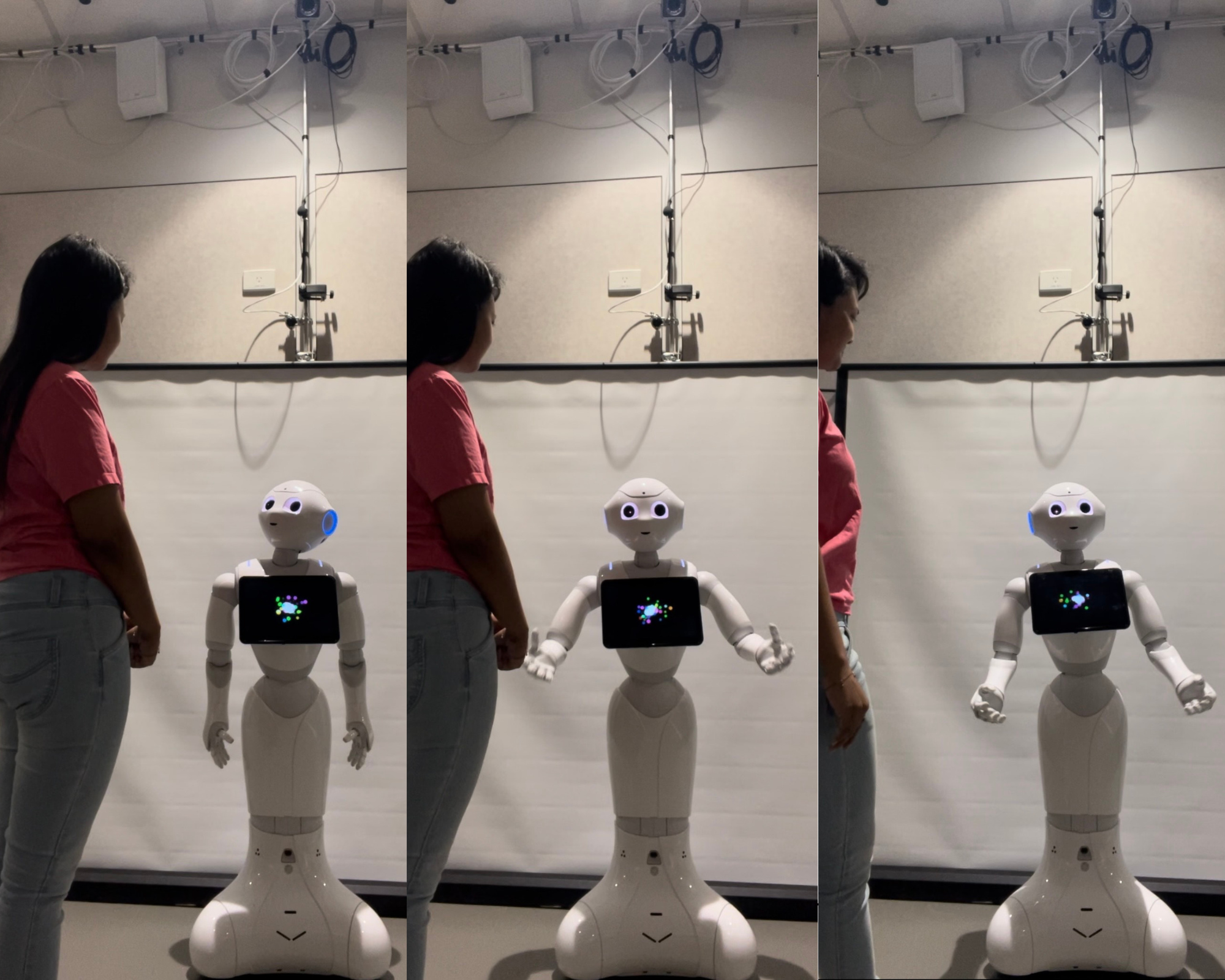
    Human beings possess a unique and highly evolved capacity to dynamically regulate their level of social presence in response to environmental cues, social norms, and contextual expectations—a capability that plays a crucial role in shaping Human-Robot Interaction (HRI). Yet, its modulation remains an underexplored area in embodied robotic systems. This research advances the field by systematically redefining social presence within HRI and developing a novel framework for its dynamic modulation.

    Maleen's Publications

    Adaptive Gaze Modulation in Social Robots: A Reinforcement Learning Approach to Attention Regulation
    Oct 19, 2025 More 10.1109/IROS60139.2025.11247106

    In this paper, we present a novel framework for robotic attention modulation that enables dynamic regulation between attention-seeking and attention-avoidance behaviours through gaze feedback. For this feedback, we incorporate SGE with gaze fixation counts to create a metric that evaluates not just the quantity but also the quality of visual attention. Our approach implements two complementary modules, a Gaze Avoidance Module (GAM) and a Gaze Garnering Module (GGM), both powered by reinforcement learning (RL) algorithms that respond to real-time human gaze patterns. Thus the system continuously adapts to each individual’s current gaze feedback level, dynamically calibrating the robot’s attention-modulating behaviours to match personal attention thresholds. This personalisation ensures that the robot can effectively engage with users when needed, while remaining unobtrusive when appropriate, all based on real-time analysis of human gaze patterns.


    Real-time social presence modulation of embodied ai-based robots: An audio-centric approach
    Aug 17, 2025 More

    This paper introduces the initial phase of a dynamic SP framework, emphasizing context identification. Psychological research links contextual awareness to improved interactions, fostering empathy and adaptability. Applying this to HRI may enhance comfort and support by mirroring social dynamics. Accurate context identification is crucial, as it directly enables effective SP modulation.


    Capabilities2 for ROS2: Advanced Skill-Based Control for Human-Robot Interaction
    Jun 30, 2025 More 10.1109/HRI61500.2025.10973863

    This paper presents Capabilities2, an advanced skill-based control framework for human-robot interaction (HRI) in ROS2. Capabilities2 enables robots to perform complex tasks by defining and managing skills, which are modular units of functionality. The framework facilitates interoperability, communication, and service management between different components of the robot system, enhancing the robot's ability to interact effectively with humans.


    Exploring Dramaturgical Potential in Human-Robot Ensembles: A Practice-as-Research Investigation through Devised Physical Theatre
    Jan 15, 2025 More

    This paper investigates the dramaturgical potential of human-robot ensembles through a practice-as-research approach, utilizing devised physical theatre to explore new dimensions of human-robot interaction.


    Reframing Social Presence for Human Robot Interaction
    Jan 15, 2025 More 10.5555/3721488.3721751

    This paper presents a new framework for understanding and designing social presence in human-robot interaction, based on empirical studies and theoretical analysis.